
The automotive industry is undergoing one of the most profound transformations in its history. While discussions often centre on electrification or autonomous driving, the real paradigm shift is driven by software. The emergence of the Software Defined Vehicle (SDV) marks a transition from hardware-centric engineering to software-centric value creation. Yet this shift is not merely technological, but also cultural: it fundamentally changes how innovation takes place.
At the heart of this transformation lies a critical question: How should software be developed in an industry defined by complexity, safety, and global competition? Increasingly, the answer points towards open collaboration within ecosystems. However, not all “open” approaches are created equal. The distinction between single-vendor open source and other approaches, such as foundation-driven open collaboration, is becoming decisive for the future of SDV.
The limits of traditional development models
For decades, automotive innovation was built on tightly controlled supply chains, proprietary systems, and deeply integrated engineering processes. This model worked well in a world dominated by mechanical complexity. Software, however, changes the equation.
Modern vehicles require continuous updates, connectivity, cybersecurity, middleware integration, and data-driven services across their entire lifecycle. Much of this software is not competitively differentiating, but it is necessary infrastructure. Yet historically, each company has developed these building blocks independently and from scratch for every hardware variant.
This approach no longer scales. The complexity is too high, development cycles are too slow, and the duplication of effort is economically inefficient. Traditional approaches such as standardisation bodies, where specifications are negotiated before implementation, also struggle to keep pace. They tend to be slow, compromise-heavy, and often fail to deliver true interoperability.
As a result, the industry is moving towards a “code-first” approach, where real implementations precede formal standards. This is where open source comes into play; but the way it is structured makes all the difference.
Open source is not enough
Open source is often seen as the solution. By definition, it allows software to be used, studied, modified, and redistributed (which is referred to as the “Four Freedoms” [1]). However, this definition says nothing about how collaboration actually takes place.
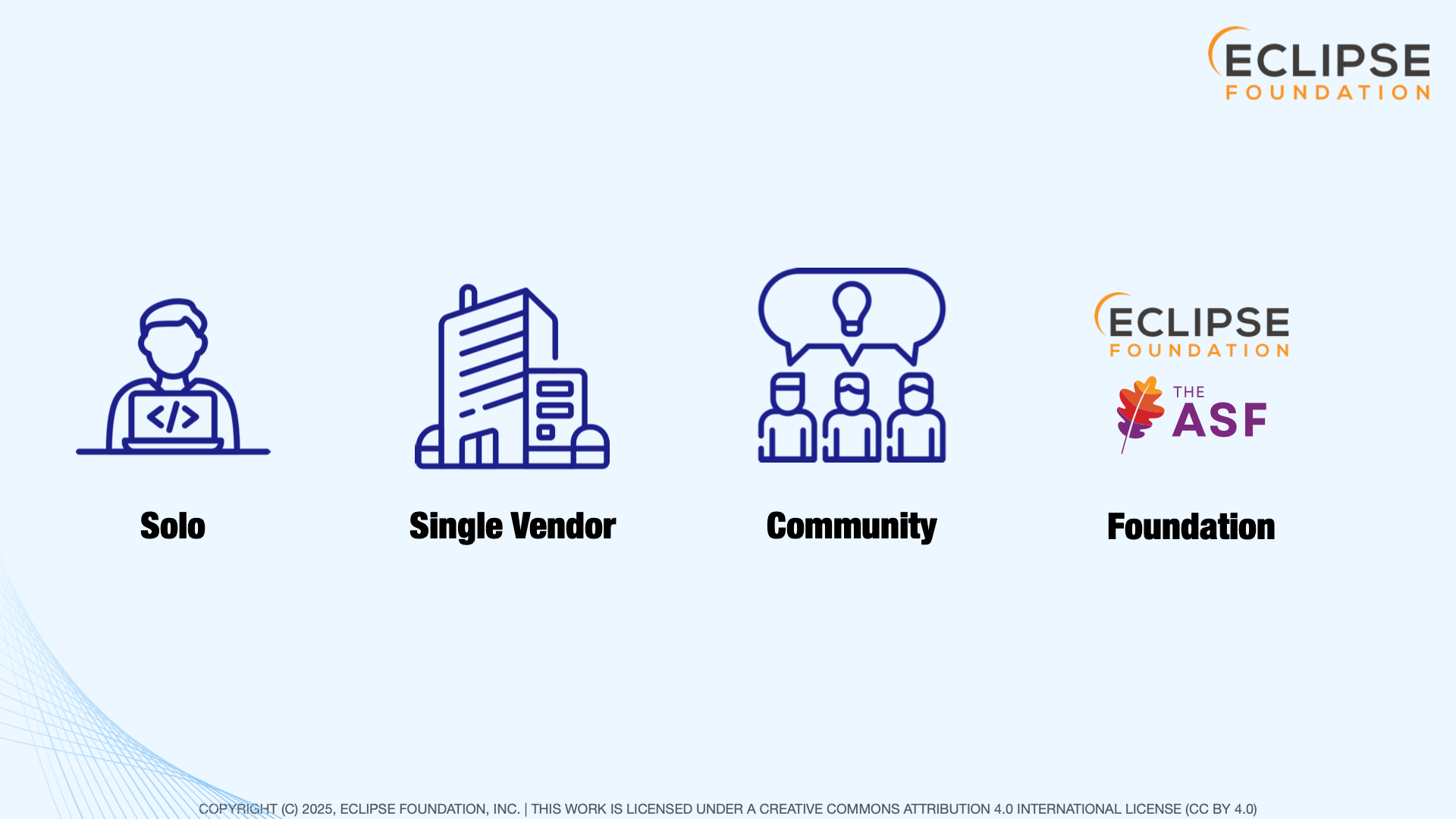
In practice, many open source projects today are controlled by a single company [2]. This model, commonly referred to as single-vendor open source, offers visibility into the code but keeps strategic control centralised. The vendor defines the roadmap, governs contributions, and ultimately determines the direction of the project.
While this model can accelerate development in the short term, it presents clear limitations in an industrial context:
- Limited trust: Competitors are reluctant to invest in a project controlled by another market participant.
- Asymmetric influence: Contributions (or meritocracy) do not necessarily translate into decision-making power.
- Strategic risk: The controlling vendor may change direction, licensing, or governance.
For industries such as automotive, where collaboration across competitors is essential, this model is often insufficient. Transparency alone is not enough. What matters is shared control and neutral governance.
The case for foundation-driven open collaboration
This is where foundation-driven open source comes into its own. Organisations such as the Eclipse Foundation provide a fundamentally different model, one that goes beyond open code to enable open collaboration.
In a foundation-driven model, several core principles are upheld:
- Vendor Neutrality: No single company controls the project.
- Transparency: Decisions are made openly and are traceable.
- Meritocracy: Influence is earned through contributions, not market power.
- Open participation: Any qualified actor can contribute under clearly defined rules.
These principles create what is often described as a level playing field, a prerequisite for sustained collaboration among competitors. At the same time, it goes beyond community-led open source projects in the sense that it provides a clear governance framework.
In the context of SDV, this model is particularly powerful. It allows companies to jointly develop non-differentiating software layers – such as middleware, runtime environments, or connectivity frameworks – while still competing on top of them. In other words, collaboration and competition are not mutually exclusive. They are simply relocated to different layers of the value chain.
Why ecosystems are no longer optional
The increasing software complexity of vehicles makes it impossible for any single company to build everything alone. SDV architectures consist of interconnected components, platforms, and services that require continuous evolution. Complexity calls for developers expert not only in embedded software development, but also in orchestration and cloud-based solutions.
This is where ecosystems become essential. Not as a buzzword, but as an industrial necessity. Foundation-driven open collaboration provides the structural backbone for such ecosystems. It enables:
- Shared investment in common building blocks
- Faster innovation through collective learning
- Reduced duplication of effort
- Improved interoperability through real code, not just specifications
Importantly, ecosystems also reshape business models. Companies must learn to differentiate above the shared software base rather than within it. This shift can be uncomfortable, particularly for players whose previous business models relied on proprietary complexity.
The role of the Eclipse Foundation
The Eclipse Foundation has emerged as a key enabler of this new model in the SDV space, as exemplified by the integration software project Eclipse S-CORE [4] that is being driven by a plethora of OEMs, Tier-1 providers, and various other stakeholder companies. Rather than developing software itself, the Eclipse Foundation provides the infrastructure, governance, and processes required to transform individual contributions into a functioning ecosystem.
Its role spans several critical areas:
- Collaboration infrastructure: Hosting projects, managing builds, and supporting release processes
- Governance frameworks: Defining roles, decision-making processes, and conflict resolution mechanisms
- Intellectual property and licensing management: Ensuring legal clarity and compatibility
- Ecosystem development: Connecting stakeholders and fostering active communities
- Compliance and security: Addressing regulatory requirements such as supply chain security and software transparency
Through initiatives such as the Eclipse SDV Working Group [5], the Foundation brings together OEMs, suppliers, and technology providers to collaborate on real codebases, not merely on concepts.
From technology to mindset
Despite the technological advantages, successful collaboration in SDV ecosystems ultimately depends on mindset.
Organisations must reconsider deeply ingrained assumptions:
- Not all software needs to be proprietary, and not all IP is valuable
- Early openness is more valuable than late-stage release
- Investing early with strategic contributions allows for first mover privileges
- Collaborative development enables risk sharing
- Community building is as important as code development
- Developers are strategic assets, not merely execution resources
Many open source initiatives fail not because of technical shortcomings, but because internal structures remain aligned with control, exclusivity, and traditional supplier relationships.
The transition to open collaboration requires alignment across management, legal, procurement, and engineering. It is as much a cultural shift as it is a technical one.
Lessons for innovation projects
The implications extend beyond the automotive industry. Publicly funded innovation projects and cross-industry initiatives face similar challenges: multiple stakeholders, diverse interests, and the need for scalable outcomes.
Key lessons include:
- Start openly from the outset: Waiting until the end to release results limits impact
- Focus on tangible artefacts: Code and prototypes enable more effective collaboration than abstract specifications
- Actively build ecosystems: Collaboration does not happen automatically
- Enable participation: Real impact comes from contribution, not just adoption
- By adopting foundation-driven models, such initiatives can significantly enhance their relevance, sustainability, and practical impact.
Conclusion: Collaboration as a competitive advantage
The transition to Software Defined Vehicles marks the emergence of a new industrial logic. Modern premium vehicles already contain more than 100 million lines of code. This number is projected to rise to 300 million by 2030 [7], making vehicles among the most complex software systems in everyday use. At the same time, 45% of automotive OEMs surveyed identify SDVs as their highest strategic priority, ahead of both advanced driver assistance systems (34%) and electrification (31%) [8].
No single company can efficiently develop and maintain this growing software stack alone. Shared challenges such as operating systems, middleware, cybersecurity, and cloud connectivity increasingly require industry-wide collaboration.
Eclipse SDV, and especially integration projects such as Eclipse S-CORE, demonstrate how this can work in practice. Under the neutral governance of the Eclipse Foundation, leading OEMs, suppliers, and technology companies are building a shared, production-ready software foundation for future vehicles. By collaborating on non-differentiating software, participants can reduce duplication, accelerate innovation, and focus resources on the features and services that create customer value.
Beyond efficiency, initiatives such as Eclipse SDV also strengthen European technological sovereignty by enabling industry-led development of critical software infrastructure through open, transparent, and vendor-neutral collaboration. In its recent Communication on European Tech Sovereignty, accompanied by an EU Open Source Strategy, the European Commission explicitly mentioned Eclipse SDV as a model for industrial collaboration in the automotive domain [9].
The future of automotive will be built in ecosystems, not in isolation. Organisations that engage early in initiatives such as Eclipse S-CORE have an opportunity not only to shape the foundations of next-generation mobility, but also to help define the future of software-driven innovation in Europe and beyond.
About the Author
Sara Gallian leads the Eclipse Software Defined Vehicle Working Group (Eclipse SDV) on behalf of the Eclipse Foundation. She has a background in Aerospace and Electrical engineering, with a PhD on numerical modeling of complex systems in the field of Electrical Engineering and Information Technology. Sara started her career in automotive as a developer for ADAS functions for a major Tier 1, and from there moved on to project and line management.
References
[1] https://wiki.opensourceecology.org/wiki/4_freedoms
[2] https://eclipsesdv.org/blogs/googles-aaos-sdv-open-source-and-the-open-question-of-governance/
[3] https://speakerdeck.com/ivargrimstad/advance-your-career-with-open-source?slide=14
[4] https://eclipse.dev/score/
[5] https://eclipsesdv.org/
[6] https://projects.eclipse.org/projects/automotive.score/who
[7] https://unece.org/sustainable-development/press/un-regulations-cybersecurity-and-software-updates-pave-way-mass-roll
[8] https://iot-analytics.com/software-defined-vehicles-adoption-4-dimensions-leading-oems/
[9] See footnote 79 in: 1. COM(2026) 503 - Communication on European Tech Sovereignty and EU Open Source Strategy: https://digital-strategy.ec.europa.eu/en/library/communication-european-tech-sovereignty-accompanied-eu-open-source-strategy