
Access to medical technology and the open source paradigm
Medical imaging technologies are fundamental tools for early detection, accurate diagnosis, and effective treatment of various medical conditions. Due to the high cost of ownership, lack of qualified staff, and intellectual property (IP) protection of technical details related to maintenance and repair, their distribution and use in countries around the world is significantly limited (WHO,n.d.), especially for magnetic resonance imaging (MRI).
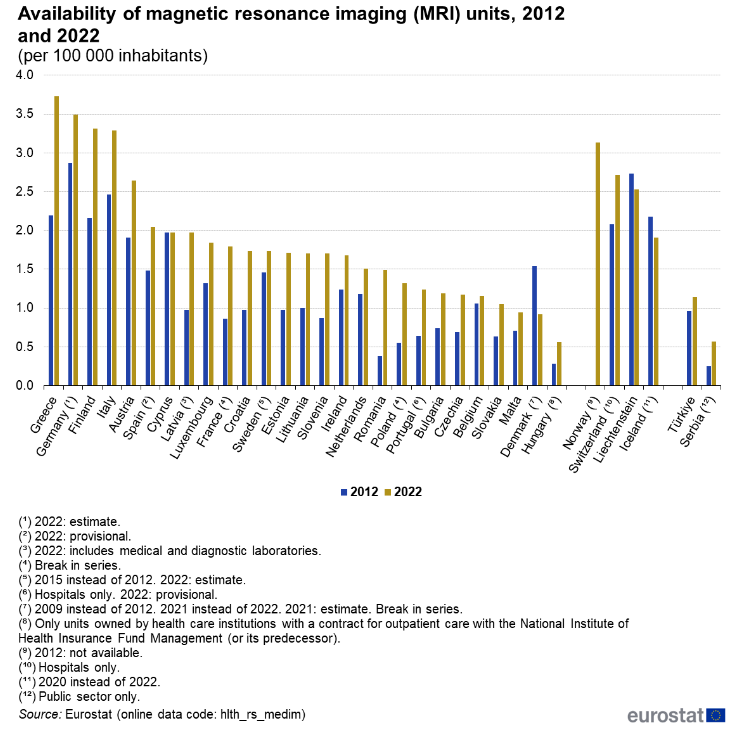
Figure 1 highlights the striking disparities in this distribution across the European Union, with differences of up to a sevenfold lower number of machines depending on the member state.
As a result, restricted access to crucial diagnostic services hinders early disease detection and treatment with all its consequences in terms of patient health and increased costs for the healthcare systems (McGarvey et al. 2022).
Therefore, improving access to medical imaging technologies has become a top priority for the relevant communities (ISMRM 2019, 2024; Wilson et al. 2019; World Health Organization 2023; Fleming et al. 2021).
Current solutions to this problem require heavy investments in devices, infrastructure and training, which however are also the source of the problem itself. More recently, collaborative initiatives based on open source medical technologies have begun to emerge, offering a different yet promising approach to improving resource efficiency across public healthcare systems in the European Union and globally (Winter et al. 2019).
Open source refers to a development and IP scheme where material is made available for anyone to study, use, modify and (re-)distribute – free of charge, non-exclusively, and irrevocably. For open source software (OSS), this means that its source code is available under licenses granting those rights (Open Source Initiative 2006; “What Is Free Software? - GNU Project - Free Software Foundation” n.d.); for hardware, the complete technical documentation must be made available under equivalent terms (“Open Source Hardware - Part 1: Requirements for Technical Documentation” 2020). This paradigm of free information flow enables a low-threshold global collaboration on technological commons.
Today, there is strong evidence that open source constitutes the dominant development model in the software domain. OSS is contributing €65-95 billion annually to the EU economy (Directorate- General for Communications Networks et al. 2021), and up to $8.8 trillion globally (Hoffmann, Nagle, and Zhou 2024).
OSS is established and ubiquitous, and its positive impact on lower income countries is being increasingly recognized (Living Open Source Foundation 2024).
These trends are also diffusing into the medical domain, where certified medical software on an open source basis becomes available.
Similar to software, open source hardware (OSH) development is primarily community-driven, taking place in online environments that facilitate large-scale collaboration under the absence of restrictive IP policies (Moritz, Redlich, and Wulfsberg 2018). OSH bears the potential to achieve faster and more cost-efficient development cycles compared to proprietary hardware, partly due to network effects and strong participatory elements (Heikkinen et al. 2020).
The cost savings alone can range around e.g., 90 % for lab equipment, compared to proprietary equivalents (Pearce 2020), whereby a resilient manufacturability is at the very heart of the concept of OSH (Hassan, Mies, and Jochem 2023). Similarly, a study published by the European Commission has quantified the cost–benefit ratio of open source technologies at over 1:4. With appropriate investment, open source may be rapidly recognized as a key enabler — not only for resilient and accessible technologies, but also as a significant contributor of Europe’s GDP growth and ICT start-up ecosystem (Directorate-General for Communications Networks et al. 2021).
Yet, OSH appears to be primarily driven by volunteer- or research-led communities, with industry participation and market capitalization still significantly lower than in the OSS domain. OSH did not only emerge about 20 years later than OSS, but also scales slower. An obvious explanation for this are physical limitations: OSS operates entirely in the digital realm, allowing easy copying, modification, and distribution at minimal cost. In contrast, OSH involves creating physical artifacts from digital designs, which requires physical production, making updates, modifications, and distribution far more difficult and costly. As a result, OSH designs tend to persist longer, development is slower and more expensive, and more dependent on precise and complete documentation (Malinen et al. 2010).
In particular for the development of medical technologies, documentation standards and best practices are therefore key to being able to transition community driven hardware prototypes into fully functional safe and certified medical products released and distributed by companies.
In contrast to consumer hardware markets, where open designs are often viewed as a competitive disadvantage in private investment-driven environments, medical hardware offers compelling incentives for adopting an open source strategy.
A simple and good example is the open source glia stethoscope. It can be produced with locally available materials and tools at about 1.7 % of the costs of an equally performant commercial model (Pavlosky et al. 2018).
Supporting and investing in open source hardware and its infrastructure for critical medical technologies, such as magnetic resonance imaging and ultrasound, offers a high return on investment in the form of sustainable long-term cost savings for public healthcare systems across the European Union and objective evaluations of the clinical performance of these devices (Moritz et al. 2019; Winter et al. 2019).
In order to realise such vision the following implementations are needed:
1. Public funding mechanisms to support technological base developments and technical documentations according to regulatory standards
2. Independent organizations for community building, community support and the dissemination of technology and best practices according to the envisioned goal of developing medical hardware
3. Industry partnerships to invest and transition these OSH developments into products
While point (1) and (3) requires the realisation of dedicating public funding schemes in collaboration with industry, point (2) can naturally grow, as in the case of the Open Source Imaging Initiative (OSI²), out of the community specialised in a particular application.
Open source medical imaging
The Open Source Imaging Initiative (OSI²) traces its roots to 2016, when a group of scientists and supporters realized the importance of pursuing open source MRI technology as a sustainable way to provide worldwide accessibility to medical imaging. Sharing the IP related to MRI technology not only removes one barrier to its adoption in lower resource countries, but has already expanded the research collaborations among different areas of expertise in the international community (Winter et al. 2024). In 2022, this effort led to the creation of the first open source Low Field MRI scanner, the OSI² ONE v1.0.0 (O’Reilly 2022; Winter 2022), as shown below in Figure 2.
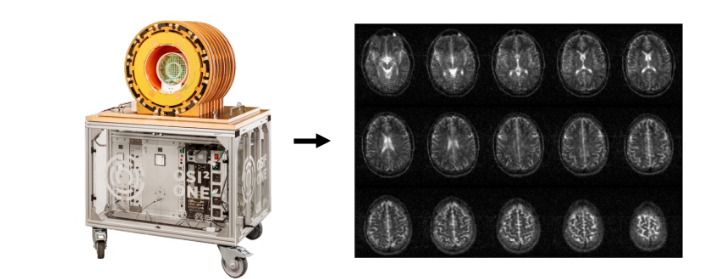
The OSI² ONE scanner has been successfully constructed in the Netherlands, Germany, Austria as well as in lower and middle resource regions such as Uganda, Paraguay and South Africa, demonstrating both the scope and applicability of the OSI² mission. Further builds are ongoing within Europe in the UK, Finland, Italy, Turkey, the Czech Republic and globally in India, Nepal and the USA.
Development of a new fully characterised version of the open source MRI scanner, aiming for an easy transition to clinical deployment, is continuing within the European EURAMET project A4IM (EURAMET, n.d.). Its aim is to have the complete image generation pipeline, from the programming of the imaging techniques, through the hardware transmission and datasampling hardware, till the image reconstruction and post-processing workflow, transparent and open source. These efforts furthermore include documentation blueprints of the system required by the European medical device regulation (MDR EU 2017/745).
First in-vivo brain images of hardware and software components developed within this project look promising (Schote et al. 2025) and are already being used by SMEs for product development. These companies actively contribute to the public repositories - an important step towards establishing an open source ecosystem around the developed technologies, where industry participation is essential to realize their full potential.
While open source developments can be initiated and funded through research projects, there is a need for an independent body to coordinate these efforts across the global community, ensure their continuation beyond the project’s lifetime, and maintain high standards of documentation and quality.
Consequently, in 2024 the international non-profit association the Open Source Imaging Initiative e.V. (incorporated in Germany) was founded to achieve the following goals:
• funding development and dissemination of open source imaging technologies through donations and grants;
• guiding others in utilizing and rebuilding open source imaging solutions;
• developing robust documentation blueprints for regulatory approval;
• acquiring and managing assets on behalf of the community;
• providing infrastructure, including workshops and digital platforms;
• growing and sustaining our global community of developers and users;
• achieving our vision of open source medical technology.
While OSI² currently focuses on MRI as its pilot technology to establish a blueprint for complex medical devices, its scope also encompasses other imaging modalities, including ultrasound and CT.
Ultrasound in particular, has received significant open source contributions over the past years (Jonveaux et al. 2022; Taylor, Jonveaux, and Caskey 2017) with many of these efforts being used and translated into a fully certified medical device.
These individual examples demonstrate the value of open source developments for clinical practice, yet a systematic approach is needed to establish an ecosystem around open source medical technologies.
Conformity Assessment Body
In contrast to OSS, OSH cannot be replicated with a single click; each reproduction requires a tangible investment—not only in time, but also in materials and associated costs.
In practice, the quality of documentation varies considerably, and even the term open source
hardware is often misused or applied without reference to a clear definition.
To address this issue, several open source communities including OSI² collaborated on the development of the standardisation document DIN SPEC 3105, which defines (1) a set of minimum criteria that a project must meet to qualify as open source hardware, and (2) a decentralised conformity assessment scheme providing independent attestations of documentation quality (Bonvoisin et al. 2020; “Open Source Hardware - Part 1: Requirements for Technical Documentation” 2020; “Open Source Hardware - Part 2: Community-Based Assessment; Text in English” 2020).
As a next step, OSI² has established a Conformity Assessment Body (CAB) in accordance with DIN SPEC 3105-2, ensuring consistent application of open source principles and sustained documentation quality within the field of medical imaging (OSII e.V., n.d.). The OSI² CAB is responsible for reviewing open source projects submitted to OSI², issuing a report and assigning a score to the reviewed project.
The report and the score helps developers to improve the quality and completeness of the project documentation and users to assess its replicability. At this stage, the review process does not aim to provide any evaluation of the technical quality and usefulness of a specific project, but rather to:
• ensure that IP rights sufficiently grant the four rights of open source, so that anyone to study,
modify, make and distribute (including to sell) the technology (“Open Source Hardware - Part
1: Requirements for Technical Documentation” 2020);
• assess the quality and completeness of the provided documentation, so that those rights can
be practically executed;
• assess the dependency of the project on proprietary third party components;
• assess the ease and feasibility of reproducing the project.
The CAB review workflow is inspired by the peer review process adopted by scientific journals. Each project is reviewed by at least two independent reviewers and the review report is publicly accessible within the CAB repository (OSII e.V., n.d.). When the review process is completed and if the project complies with minimum open source requirements, it is uploaded to the OSI² website, a DOI is associated with the reviewed version of the project, the review report is uploaded to the CAB repository (OSII e.V., n.d.) and an attestation is issued (Figure 3).
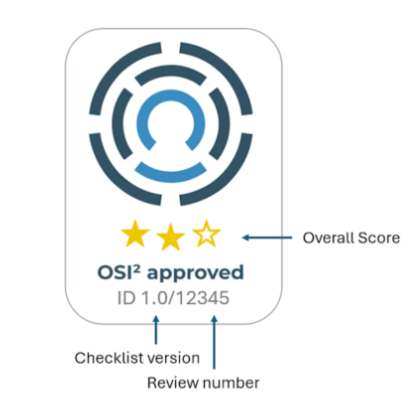
A project is associated to a specific tier according to the number of points scored during the review process. This score is based on a checklist of items, defined in accordance with DIN SPEC 3105-1 (“Open Source Hardware - Part 1: Requirements for Technical Documentation” 2020). Some of these items are mandatory to obtain the attestation while others represent an added value. The CAB repository (OSII e.V., n.d.) provides two different checklists which apply to software-based and hardware-based projects. If a submitted project includes both software and hardware parts, both checklists are applied. Projects that meet the minimum criteria (Tier 1) are also eligible for a certificate from the Open Source Hardware Association (OSHWA); the further tiers go beyond the OSHWA criteria.
In addition to the number of stars, the logo in Figure 3 also reports the checklist version and a review number which unambiguously identifies the reviewed project. The former number is useful for keeping track of future revisions of the checklists and the latter ensures a logo (as well as the underlying assessment report) is unique for each reviewed project and version.
Once the documentation quality of the projects matures over time through support of the CAB attestation, additional scores and tiers will be added to the process, which will include e.g. technical documentation as required by the Medical Device Regulation EU 20217/745 such as: Intended use and classification rationale, General Safety and Performance Requirements (GSPRs), Risk Management or product verification and validation according to international standards (e.g. IEC 60601-1). This will help to clearly distinguish the quality of open source projects and their readiness for transfer into clinical practice, creating an important publicly available source of blueprints that can be adopted to a variety of similar, also proprietary, medical products.
Conclusion
While medical imaging devices represent a cornerstone of modern healthcare, their availability remains limited — both within Europe and, even more significantly, on a global scale.
The open source paradigm offers a promising path to address this disparity by enabling collaborative development of medical devices. Through transparent information exchange — from technical design to regulatory documentation—this approach fosters stronger collaboration, more efficient use of resources, and ultimately cost reductions for public healthcare systems.
Initial demonstrations have shown that complex, functional open source prototypes such as MRI scanners can indeed be realised. Regulatory documentation for these systems is currently underway, and first steps are being taken to scale these efforts through the establishment of documentation standards coordinated by independent organizations such as OSI² e.V.
To expand and accelerate this progress, dedicated funding mechanisms and investment in pilot projects are essential—projects that clearly demonstrate the benefits of open source approaches for patients and healthcare systems alike. In this way, open source medical imaging evolves from idealism into a structured, sustainable ecosystem that delivers tangible value to both patients and healthcare providers.
About the Author
Martin Häuer is the Scientific Head for Open Standards (JTC-C1) at Martin-Luther-Universitaet Halle-Wittenberg. He is deeply engaged in the open source hardware ecosystem, mainly focusing on project coordination, documentation and governance. Martin has been active in several communities, including Open Source Ecology Germany, that he chaired for three years and where he initiated and led the development of DIN SPEC 3105 and maintained the OKH metadata standard.