
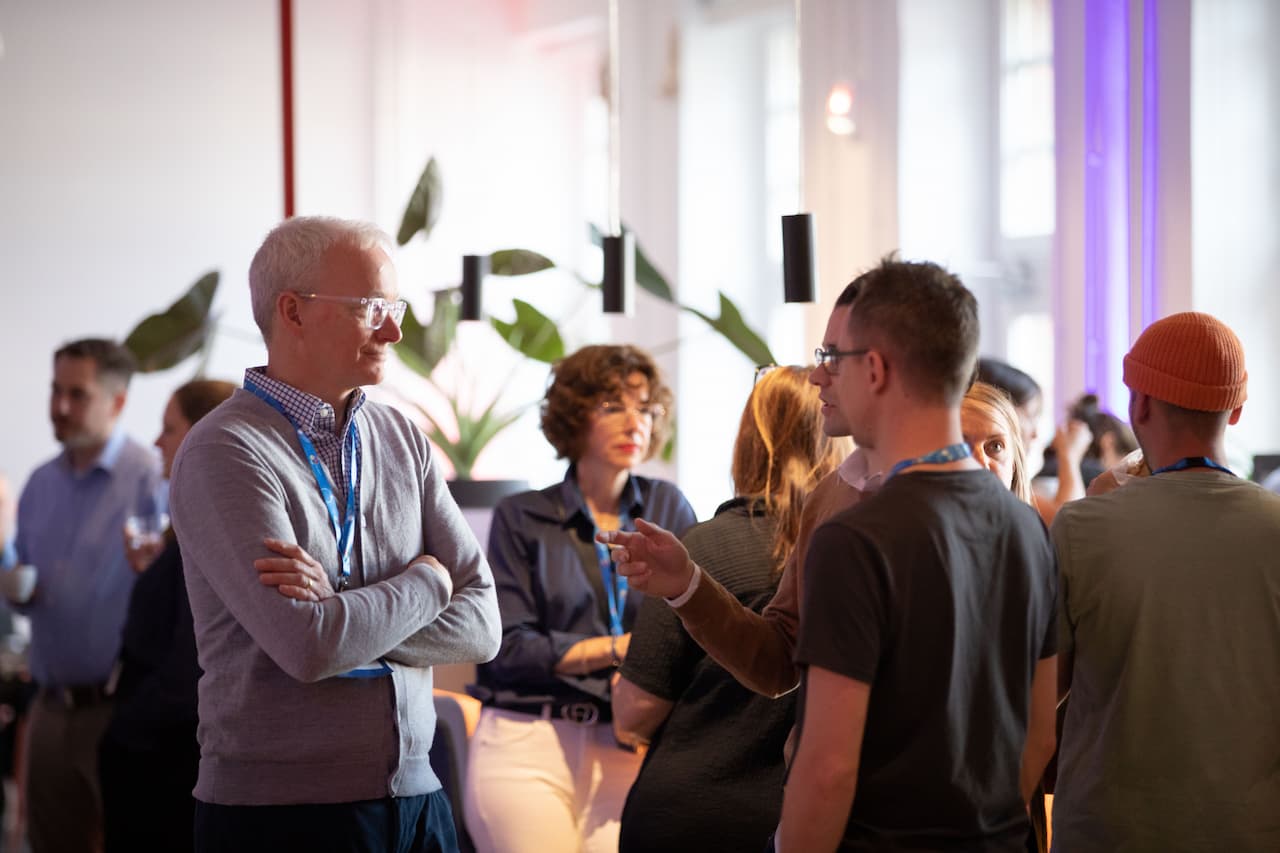
Logistics has always been a complex industry. Today, with global and digital supply chains, whose critical role in supplying households and industries worldwide became evident during the COVID-19 pandemic, that complexity has intensified to a point where no single company can solve the challenges of modern logistics alone. The scalable, interoperable, and resilient solutions that really matter emerge from communities of practitioners working together.
Open source provides the framework for industry-wide collaboration
More than just freely available software, open source in logistics is a way of working that embraces transparency and collective problem-solving. When multiple stakeholders across shippers, carriers, software developers, and regulators contribute to a shared codebase, they create tools that are more adaptable and widely usable. Solutions are therefore built with real-world conditions in mind, not just theoretical assumptions.
At the Open Logistics Foundation (OLF), we’ve seen this model in action, from the early days of defining our first project to today’s vibrant community of 50+ partners across the logistics industry.From this experience, I can see four principles that define successful open source communities in logistics – and, indeed, in any complex industry:
- Challenge assumptions: When contributors bring different expertise and perspectives, long-held assumptions are questioned, and solutions are re-evaluated before they reach production.
- Foster openness: Transparent processes and open discussions encourage experimentation and enable collective progress faster than in isolated development.
- Build resilient solutions: A community that includes multiple perspectives can anticipate operational challenges and regulatory requirements that a single organisation might overlook.
- Create shared standards: When diverse participants contribute to the same project, the resulting tools and protocols are inherently more interoperable and adoptable across organisations and countries.
All four principles depend on diversity. While “diversity” is often considered as being primarily about representation in race, gender, etc., the OLF community also works toward a diversity of professions, experiences, geographies, and perspectives. That allows communities to identify risks, challenge assumptions, and innovate effectively. This diversity is especially powerful in Europe, where logistics is inherently cross-border. Regulatory frameworks, operational practices, and levels of digital maturity vary widely across countries. Open source communities provide a neutral space for dialogue and co-creation, where stakeholders from different nations and sectors work together on common standards and interoperable solutions.

A strong governance allows diversity and trust to be the main pillars of an open source community
The impact of this approach is evident in projects like the OLF-eCMR, the first open source implementation of the electronic consignment note in logistics. While this project is only one example, it illustrates how multi-stakeholder collaboration works in practice. Developers, logistics experts, regulators, and entire companies contributed to a shared codebase using standard open source practices (e.g., open APIs, modular architecture, continuous integration and iteration). Decisions were guided not by a single authority like the OLF Head Office or its Board but by a community governance model, ensuring transparency and inclusivity. The resulting software is technically robust and, crucially, widely applicable across the industry.
In logistics, where digital transformation often involves multiple stakeholders and complex processes, ignoring diversity and community input can lead to solutions that are brittle, fragmented, or unused. Open source provides both the methodology and the cultural framework to avoid these pitfalls.
Equally important is trust. Communities succeed not simply because participants contribute code or ideas, but because there is confidence that contributions will be treated fairly and respectfully. Trust allows for honest discussion and critical feedback for more rapid iteration. Yet maintaining that trust cannot be taken for granted. According to a 2021 study by the Linux Foundation, only 55% of open source contributors felt their opinions were valued by project leadership. This shows that while open source is built on openness by design, inclusion in practice still requires conscious effort.
The power of open source lies not in the code alone, but in the culture and mindset it creates
Another lesson from our open source community is the value of shared ownership. Unlike proprietary development, where the benefits accrue to a single company, open source distributes both responsibility and reward. Every participant has a stake in the outcome. Every perspective matters. This creates a collective accountability that encourages higher-quality solutions and faster adoption.
Ultimately, the message is clear: if we want to shape the logistics industry for the future, we need to embrace community and, within it, diversity and open collaboration. This is not optional, and projects like the OLF-eCMR show what is possible when these principles are applied.Open source offers a way to tackle complexity, engage diverse perspectives, and develop solutions that endure. For logistics, this means faster, safer, more reliable supply chains. For participants, it means an opportunity to contribute to something larger than any individual company. And for the industry as a whole, it means progress that is collectively owned, collaboratively developed, and widely beneficial.
If there is one lesson I would highlight for leaders, developers, and newcomers alike, it is this: Invest in your community, embrace diversity in all its forms, and apply open source principles rigorously. The results may be challenging from all sides – technical, operational, cultural – but they will be transformative.
About the Author
Carina Tüllmann, MBA, serves as CCO of the Open Logistics Foundation, leading business development, communications, marketing, and community development. Since 2010, she has been active in logistics and supply chain management collaboration. Her dedication to open source is rooted in the belief that it strengthens the European Union’s sovereignty, resilience, inclusiveness, and innovative capacity.