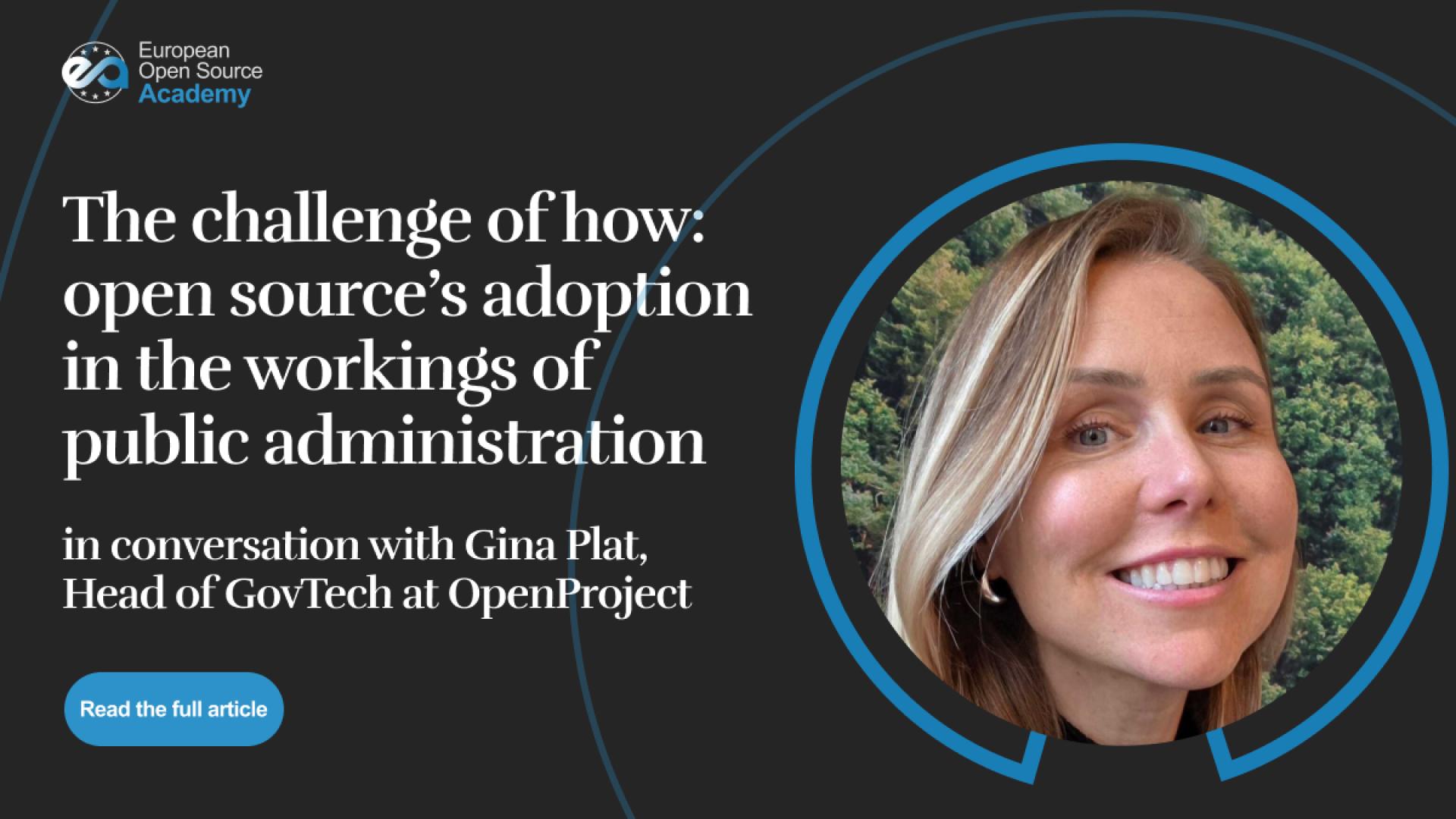
In conversation with Gina Plat, Head of GovTech at OpenProject
“The pleasant surprise is, in fact, the public administration does not need a lot of convincing to try and implement open source”. Gina Plat has spent a good part of her career in rooms where the word “open” was an aspiration, but its enactment had often times fallen short. In her position as the interim lead of the Open Source Program Office at the Dutch Ministry of the Interior and Kingdom Relations (BZK), she followed how the governments began understanding what open source is, why it is important, but they struggled with the how – adoption of open source was believed to be across all-levels and immediate, instead of considering a gradual adaptation and across various levels. Gina experiences first hand the struggles of procurement for goverments, now that she has crossed to the other side of the procurement table, joining OpenProject as its Head of GovTech. In both seats, as she describes it, the job is the same: helping public administrations, in the Netherlands and across Europe, adopt open source as a default, rather than an unfamiliar alternative option.
The Dutch setting she works in is, on paper, among the most favourable in Europe. Since 2020 the government has operated under a policy called “open, unless” (open, tenzij): software the state procures or builds should be open source unless that proves impossible. For several years the principle lived more comfortably in documents, without much incentive or repercussion to those who do not wish to switch from proprietary software. What changed, in Plat’s telling, was the arrival of digital sovereignty as a political and security concern. For example, the case of the International Criminal Court in The Hague, an institution whose day-to-day work turned out to depend on technology controlled elsewhere, made the stakes impossible to ignore. Open source, once filed under IT policy, began to be talked about as a question of security and independence, and the OSPO found itself recast as a strategic partner in delivering both. The momentum has since become institutional: on 1 October 2026, the national government, provinces, municipalities and the research network SURF signed a joint declaration making open source a permanent part of how Dutch government works.
The twists and turns of procurement
While little persuasion was needed for the governments to consider switching to open source, the adoption of open source has not always been straightforward. The initial enthusiasm always exists, but with the purchase order always came doubts. “But is it trustworthy enough, will our system be secure enough”, came in the questions from representatives. However, Gina attributes these doubts more to the unfamiliarity with it and its use, rather than examples of setbacks of using open source software.
The pioneers of successful adoption of open source do exist, however! Gina recalls the visit to Schleswig-Holstein in January 2026, the German state that has moved its administration’s email to Open-Xchange and Thunderbird and most of its workstations to LibreOffice. Seeing it working, with savings on licenses and gains in sovereignty, did more convincing than any presentation could. Plat is also careful that “going open source” should not be done with haste. To guide a smooth and gradual transition, she cites the open source ambition ladder developed at the Dutch Ministry of Health, Welfare and Sport, which sets out degrees of commitment, and reminds administrations that using, contributing to and supporting open source are equally important, and support overall transition to open source workings.
Sustainable open source adoption starts with small steps
The move to open source can be done by anyone, and Gina experienced this at one of her first places of work. Before the OSPO, she worked at an international non-profit named Mama Cash where she implemented a fully open source IT environment – everything from servers and apps to desktops. It was her first large move away from proprietary software, and albeit an NGO, the transition and equipping users to use open source had been possible. Adopting open source can be smooth if you explain to users what the reason behind choosing open source is. Then, instead of focusing on explaining the ins and outs of open source, an organisation should find its own ambassadors and champions for it, that can help build wider acceptance and desirability of using open source. Most importantly, Gina points out, is to be honest that things might look different than what people are used to, and it would require a dedicated strategy to train and build skills of its future users, just as Schleswig-Holstein government did.
But is it enough if governments only aspire to use open source? To start with, the relationship between government and open source contributors, often quite fragile, has to find a way to be sustained and beneficial for both. Governments operate on the basis of minimizing risks, while open source communities are made up of volunteers, unconfined and changeable. In order for the two work cultures to be reconciled, Gina considers five concrete ways in which government can showcase their interest in investing in open source:
• The first concerns funding: How a project gets funded depends on where it sits in the stack. Low-level components such as curl, OpenSSL and PHP often rely on one-time subsidies and maintainer funds such as Germany’s Sovereign Tech Agency and NLnet. Even modest sums can matter enormously to a small, volunteer-run project. Community applications such as Mastodon, Forgejo and F-Droid mostly run on donations and the occasional grant. Open source companies, such as OpenProject, are paid through tenders, subscriptions and support contracts. Public money mostly ends up with that last group. Gina’s suggestion: when governments tender for open source, they should build in financing for the important projects and components the solution depends on. That could be a small percentage of the contract or a maintenance pool that the supplier passes upstream.
• The second is contributing back in time, skills and code: Gina sees particular promise in governments working together with open source projects. That can mean contribution hours for civil servants or government developers acting as (co-)maintainers. It also covers work beyond code, such as documentation, translations, accessibility testing and good bug reports. One of such projects is Forgejo, with whom the Dutch government OSPO and Team Codeplatform (code.overheid.nl) started an EU codeplatform initiative to collectively build federation. This brought together pan-European open source contributors and governments. Within an open Matrix channel, the conversation continues with governments from France, Germany, Denmark, Switzerland, Sweden, Belgium, Luxembourg, Italy, the European Commission, and even Trinidad and Tobago, together with the Forgejo and Codeberg community. Another example is Mastodon; where the Dutch government developed and upstreamed accessibility features to the Mastodon community. This was very well received.
• The third, and the trickiest, is governance: helping shape roadmaps while recognizing that low-level components, community applications and open source companies each call for a different approach, but at the end of the day, it is the community that must come first. A government office, Gina concludes, cannot dominate the conversation. She points to OpenDesk, which brings open source companies together around a shared workplace suite, and to Decidim, which gave its community governance software a neutral home.
• The fourth refers to the skills and capacity building: Governments need to invest so that people in their own sector have the knowledge and skills to use and build open source. Gina stresses that this goes well beyond developers. Buyers, lawyers and policy officers decide what gets bought, what may be published and who is allowed to contribute, so they need that knowledge just as much. “Without in-house skills, every choice about your software is made by a supplier,” she says. A first step is to organise the expertise by setting up an OSPO. Money saved on licences can also go into people: Schleswig-Holstein, for example, spends part of its savings on building in-house expertise alongside its migration. And contributing should become part of the job. The European Commission’s 2026 ‘Open Source Strategy’ commits to training and recognising staff who contribute to open source. Good training doesn’t have to be built from scratch either, since the EU already offers a free e-learning course on open source for public administrations.
• The fifth encompasses policy and regulations: Rules within a government that can support the choice for open source and helps to contribute to the open source ecosystem. The ‘open unless’ policy and ‘Open source strategy’ as part of CADA by the European Commission are good examples of this. Other countries are moving too. Sweden now asks some 340 agencies to consider open source first or explain why not, and Germany’s Deutschland-Stack makes open document formats mandatory from 2028. Gina is keeping a close eye on the upcoming revision of the EU procurement directives, because it will decide how future tenders are written. She adds that market rules count as open source policy as well. The Digital Markets Act (DMA), for instance, gives open app stores like F-Droid a lever against Google’s plans for mandatory developer verification.
“Open, unless…” changing to “Open, foremost”
Even if the governments and open source community commit to a two-way collaboration, legislature should follow in solidifying such efforts. When “Open, unless” was introduced in 2020, with all good intent behind it, it carried little to no obligation. “It could become more binding”, Gina argues, “with decisions to choose ‘unless’ having to require more than a few lines of explanation”. Open source has the infrastructure and capacity to be a default, rather than a “nice-to-have” option. The exceptions to the rule, Gina proposes, could be a closed list, and with a standard requirement of justification.
The shift towards open source is happening both on national and local levels, albeit at different speeds. There is top-down support, but local governments are often implementing open source ahead of the centre, simply because digital transformation at a national level takes longer. The decentralised nature of open source suits a bottom-up movement and makes it easier to adapt locally. Several countries, among them Italy, France, Germany and the Netherlands, already encourage open source in national policy; that word, she suggests, could afford to be more binding.
For the people, by the people: democracy spelled with open source
If we have unlocked the ‘how’ to transition towards open source, what would be there to gain from the switch? Indeed, costs would be stabilized over time, and governments would have greater security and independence from single vendors. And yet, it is open source that aligns the closest to the principles of governing – it requires us to be conscious of transparency, of openness and of democratic values. With open source, these are not features, or nice-to-have. They are the very principles upon which open source is built. So, when will it become a default across Europe?
Interested in more news from the open source community?
Don't miss out from the latest contributions written by European Open Source Academy or co-written with open source experts from across Europe.