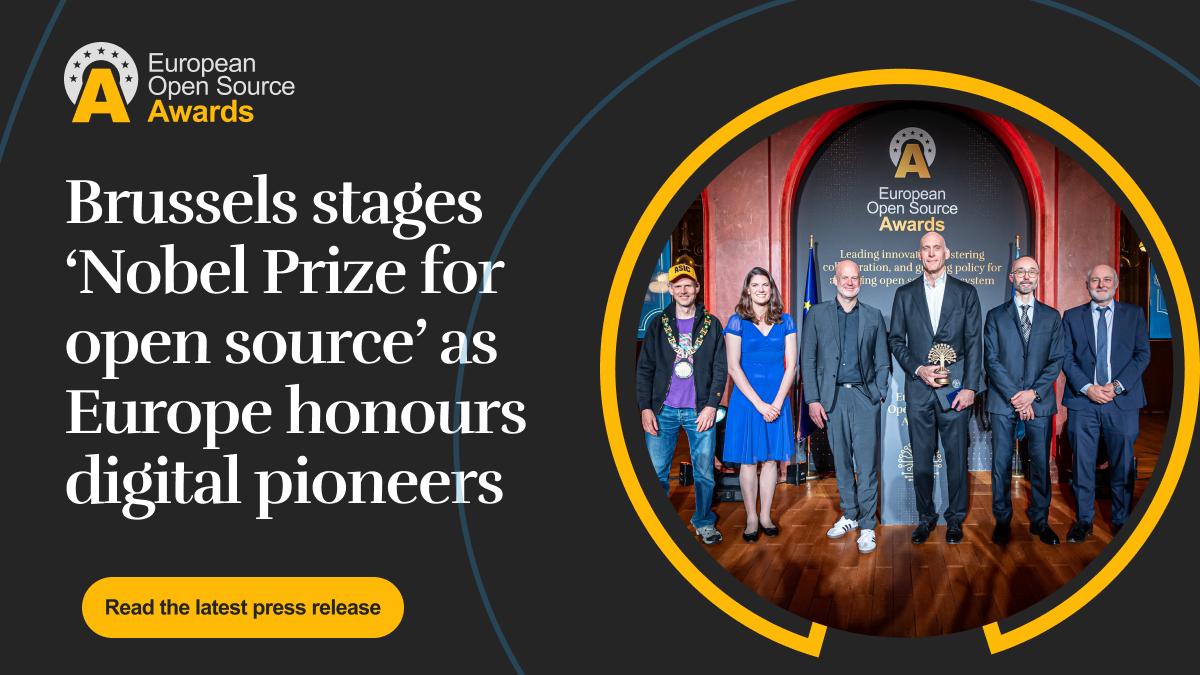
Europe’s leading open source developers and community leaders were honoured in Brussels at the 2nd Annual European Open Source Awards.
This year’s European Open Source Awards honoured the developers and community leaders who are quietly building the digital foundations of modern life. The accomplishments of these leaders were recognised at the 2nd Annual European Open Source Awards, which took place on 29 January in Brussels at the Solvay Library.
The Solvay Library building was commissioned by Ernest Solvay, the Belgian chemist and industrialist, in the early 20th century. It became a gathering place for some of Europe's greatest scientific minds, including hosting the legendary Solvay Conferences, where Einstein, Curie, and other luminaries debated the foundations of quantum mechanics. It's fitting to hold the European Open Source Awards there – a space dedicated to collaborative scientific inquiry – to celebrate the open source community's commitment to shared knowledge and collective innovation.
Improving Public Recognition of Open Source
The ceremony recognised some of the most influential leaders from Europe in the global open source movement, improving public recognition of its impact and the people driving. Open source software underpins the software and hardware systems that power everything from cloud computing and artificial intelligence to hospitals, energy networks, and public services – all at a time when control over digital infrastructure has become a strategic issue for Europe.
As governments across the continent invest heavily in AI, cybersecurity, cloud computing, and digital sovereignty, attention is therefore increasingly turning to the people who actually build and maintain the open technologies that make these ambitions possible. Open technologies are seen as offering choice and control at a time when licensing or use of proprietary systems and commercial off-the-shelf solutions remains dominant.
Daniel Stenberg, President of the European Open Source Academy, said: “These Awards are a peer-led recognition of work that underpins modern digital life for the pioneers who rarely receive public attention. We want this to feel like the open source version of the Nobel Prize.”
Awarding Europe’s Leaders in the Global Open Source Movement
The Prize for Excellence in Open Source, the highest honour of the evening, designed to honour long-term leadership and accomplishments in open source, was awarded to Greg Kroah-Hartman, one of the world’s most influential software engineers and a long-standing maintainer of the Linux operating system, which runs much of the world’s servers, smartphones, data centres, and industrial systems.
Often described as the invisible backbone of the digital economy, Linux underpins vast parts of global computing, from financial markets and cloud platforms to telecommunications and critical national infrastructure. Mr Kroah-Hartman was also recognised for his outstanding contributions as a community leader and mentor in the open source movement. At a time of geopolitical tensions, his origins in the United States and impact in Europe – where he has long resided – offer a compelling illustration of the global nature of open source.
Alongside Mr. Kroah-Hartman, four further awards recognised individuals whose work has shaped Europe’s open source ecosystem and its impact on society, security, and economic competitiveness. The Special Recognitions were designed to hire other diverse contributions from Europe to the global open source ecosystem.
Frank Karlitschek, founder and CEO of Nextcloud, received a Special Recognition for Business and Impact for building one of Europe’s leading sovereign cloud platforms, offering an open alternative to US-based technology giants and enabling organisations to retain control over sensitive data.
Jenny Molloy, senior researcher at the University of Cambridge and Great Ormond Street Hospital, was awarded Special Recognition for Advocacy and Awareness for her work championing open science and open technology in healthcare, helping accelerate research collaboration and medical innovation.
The Special Recognition for Skills and Education Award went to Matt Venn, founder of TinyTapeout, whose open hardware platform has enabled thousands of students and engineers to design and manufacture their own microchips, dramatically lowering the barrier to entry into semiconductor design.
Finally, the Special Recognition for Community Impact Award was awarded to Software Heritage, the world’s largest archive of open source software, and was jointly received by Roberto Di Cosmo and Stefano Zacchiroli for their work buildingg the Software Heritage project and community. Their work has helped to preserve the digital building blocks of modern society, safeguarding critical software infrastructure for future generations.
Peer-Led Excellence
Last year’s award recipients now form the leadership of the European Open Source Academy, acting as custodians of the Awards and shaping the selection of future Laureates and Honourees. Together, they form a peer-led panel that evaluates nominations, shortlists candidates, and guides the strategic direction of the Awards. All of this year’s award winners have been invited to join the Academy.
This structure places the Awards alongside the most respected peer-led honours in science and technology, ensuring that recognition is driven by technical excellence, community impact, and long-term contribution rather than institutional or political agendas. The Academy is on its path towards becoming the body for recognising and strengthening public recognition of the value of open source in Europe and beyond.
Held as part of EU Open Source Week, the 2nd Annual European Open Source Awards sought to bring in a diverse audience, including policymakers, industry leaders, researchers, and developers at the Solvay Library in Brussels, highlighting the growing recognition that open source has become strategic infrastructure for Europe.
Silent Builders Honoured
The European Open Source Awards aim to change the attitude towards open source in Europe, bringing public recognition to the silent builders contributing to Europe’s economic and technological resilience through open collaboration and innovation.
Speaking at the ceremony, organisers said the awards reflected a broader shift in European thinking.
“Open source is increasingly becoming a strategic choice,” said Stenberg. “Europe’s ability to remain innovative, secure, and competitive increasingly depends on open technologies and especially the people behind them. These awards exist to give that contribution the public recognition it deserves.”
The European Open Source Awards are held annually in Brussels and form part of a wider effort to strengthen Europe’s open source ecosystem, foster skills development, and support digital sovereignty across industry, government and research.
For more information about the European Open Source Awards:
● Mail to: press@europeanopensource.academy
● Visit https://awards.europeanopensource.academy.
● Sign up for the European Open Source Academy newsletter
https://europeanopensource.academy
● Follow the European Open Source Academy on LinkedIn
https://www.linkedin.com/company/eosacademy1